From Schrödinger’s diaries to Newton’s gallows, a look at the deeply dark human realities behind history’s greatest equations—and the rare few who chose a different path.
If you open any high school physics textbook, you are greeted by a gallery of secular saints. They stare out from the pages in airbrushed portraits or smooth marble busts - stoic, solemn, and seemingly operating on a higher moral and intellectual plane than the rest of humanity. We teach their laws, their constants, and their equations as if they dropped directly from a heaven of pure logic. History has a bad habit of flattening human beings into flawless icons and if we turn scientific contributions into a licence for saintly immunity, we erase the very real victims of these individuals’ actions, and we fall into the trap of believing that exceptional intellect grants moral immunity. The truth is, as always, far messier than we’d like it to be. Those who mapped the universe were human - with all the failing and hypocrisies of the condition. In many cases, vindictive, cruel, predatory, or actively aligned with the worst atrocities of their eras. To look at them clearly is not to erase their physics; it is to accept that a human mind can calculate the curvature of spacetime or the behavior of an electron while remaining deeply, sometimes monstrously, flawed. Here are some unvarnished snapshots of the names in your textbook.
Part I: The list
Erwin Schrödinger (1887–1961)
- The Textbook Legacy: The wave equation, quantum mechanics, and the famous “Schrödinger’s Cat” thought experiment.
- The Human Reality: Schrödinger’s private diaries, which came to light fully in biographic reviews, revealed that his genius coexisted with a lifelong history of predatory behavior. He was a serial groomer who kept meticulous, chilling logs of his sexual relationships with young girls, frequently targeting the teenage daughters of his friends, colleagues, and acquaintances. He used his prestige and status to gain access to them, often under the guise of math tutoring, operating with an impunity that his scientific celebrity afforded him.
⠀Robert Hooke (1635–1703)
- The Textbook Legacy: Hooke’s Law of Elasticity (F = -kx), the invention of the balance spring, and coining the biological term “cell.”
- The Human Reality: While popularized history falsely claims he married his niece, the reality found in his own diaries paints a darker picture (Mulligan, 1996). When his brother died, Hooke became the legal guardian of his niece, Grace Hooke, who came to live with him around the age of 10. By the time she was a teenager, Hooke had initiated a long-term sexual relationship with her. He was an intensely possessive guardian, sabotaging her marriage prospects to keep her under his roof as his live-in partner until her death at 27. His diaries also reveal he used his position of absolute household authority to engage in sexual relationships with a revolving door of young maidservants, tracking his encounters using the astrological symbol for Pisces (♓︎)—traditionally linked to Venus and physical desire—to denote his orgasms.
⠀Richard Feynman (1918–1988)
- The Textbook Legacy: Quantum electrodynamics (QED) and the intuitive “Feynman diagrams” used by every modern particle physicist.
- The Human Reality: Pop culture remembers Feynman as the quirky, bongo-playing, lovable rogue of the Manhattan Project. However, his relationship with women was profoundly toxic. In his autobiography, Surely You’re Joking, Mr. Feynman!, he openly recounts learning psychological manipulation tactics from a pimp to treat women with disrespect so they would sleep with him (Feynman, 1985). Furthermore, during her 1956 divorce proceedings, his second wife, Mary Louise Bell, testified to “extreme cruelty,” painting a picture of an emotionally volatile home life. She noted he had a frightening temper, played his drums constantly, and was so entirely consumed by his physics that he did calculus in his head from the moment he woke up, while driving his car, and even while lying in bed (Gleick, 1992). Feynman pops up again when we get to Millikan, the man that inspired this whole post…
⠀William Shockley (1910–1989)
- The Textbook Legacy: Co-inventor of the transistor, Nobel laureate, and the founding father of Silicon Valley.
- The Human Reality: Shockley spent the latter half of his life using his Nobel platform to aggressively champion white supremacy and an ideological concept he termed “dysgenics” (Shurkin, 2006). He surged into a massive public campaign proposing that anyone with an IQ below 100 should be financially incentivized by the government to undergo voluntary sterilization, arguing that Black people were genetically inferior in intelligence to white people.
⠀Philipp Lenard (1862–1947) & Johannes Stark (1874–1957)
- The Textbook Legacy: Nobel Prizes for cathode rays (Lenard) and the splitting of spectral lines in electric fields (the Stark Effect).
- The Human Reality: Lenard and Stark were the fanatical architects of Deutsche Physik (”Aryan Physics”) under the Nazi regime (Ball, 2014). Infuriated by the success of Albert Einstein, they rejected relativity and quantum mechanics as corrupt “Jewish Physics.” They weaponized their political power to purge Jewish scientists from German universities, and Lenard became a high-ranking scientific advisor to Adolf Hitler, actively assisting in the systemic destruction of Europe’s scientific community.
⠀Wernher von Braun (1912–1977)
- The Textbook Legacy: Aerospace pioneer and rocket physicist who designed the Saturn V rocket that propelled Apollo 11 to the moon.
- The Human Reality: Before he was a NASA hero, von Braun was a Nazi SS officer. He was the mastermind behind the V-2 rocket program, which was constructed using enslaved labor from the Mittelbau-Dora concentration camp (Neufeld, 2002). Historical records show von Braun personally walked through the horrific, subterranean tunnels where thousands of prisoners starved, worked, and died of disease in pitch darkness. More people died building von Braun’s rockets (an estimated 20,000 prisoners) than were ever killed by the weapons hitting their targets. After the war, his Nazi record was systematically whitewashed by the U.S. government under Operation Paperclip.
⠀Isaac Newton (1642–1727)
- The Textbook Legacy: Calculus, the laws of motion, and universal gravitation.
- The Human Reality: Newton was famously paranoid, spending decades trying to utterly destroy his rivals, Leibniz and Hooke, going so far as to allegedly burn Hooke’s only portrait when he took over the Royal Society (Westfall, 1980). But his darkest chapter came when he was appointed Warden of the Royal Mint. Newton turned into a ruthless, obsessive inquisitor (Levenson, 2010). He donned disguises, frequented the London underworld, and used psychological torture and bribery to hunt down counterfeiters. When he caught his primary target, a con-man named William Chaloner, Newton showed zero mercy, systematically ensuring Chaloner was sentenced to the gallows to be hanged, drawn, and quartered while ignoring his desperate letters begging for his life.
Whilst we’re here I can’t resist a Newton story:
In a 1676 letter to his rival Robert Hooke, Newton wrote the famous line: “If I have seen further, it is by standing on the shoulders of giants.” It is quoted endlessly as evidence of Newton’s gracious acknowledgement of those who came before him. It’s even on some of the UK’s currency:
 The UK £2 coin
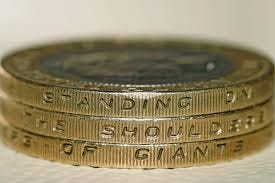
The problem is that he wrote it to Hooke — a man who was notably short, and physically misshapen from scoliosis, and with whom Newton was engaged in a vicious priority dispute at the time. Many historians now read it not as a gesture of intellectual modesty, but as a carefully aimed insult: a reminder to Hooke that he was not, and never would be, one of the giants in question…
⠀Albert Einstein (1879–1955)
- The Textbook Legacy: Special and General Relativity, E=mc^2
- The Human Reality: Publicly, Einstein was an exemplary humanist, a socialist, and a vocal supporter of the U.S. Civil Rights movement. But human beings are capable of profound compartmentalization. When his private travel diaries from the 1920s were published, they revealed a shocking undercurrent of xenophobia (Einstein, 2018). Writing of his travels through Asia, he described the people of Ceylon (Sri Lanka) as living in “great filth” and doing “little, and need[ing] little,” while describing the Chinese as “industrious, filthy, obtuse,” writing that “it would be a pity if these Chinese supplant all other races.”
⠀Part II: A deeper dive - Robert Millikan, Eugenics, and a Contested Cancellation
Robert Millikan (1868–1953)
The Textbook Legacy: Nobel laureate who famously measured the elementary charge of an electron with his oil-drop experiment, was the founding president of Caltech and an alleged eugenicist.
The Human Reality — and Why It’s Complicated:
In the first version of this post, I was planning to tell the tale of how one of the best experimentalists not only cheated, but also supported a horrific movement. Then it got more complex.
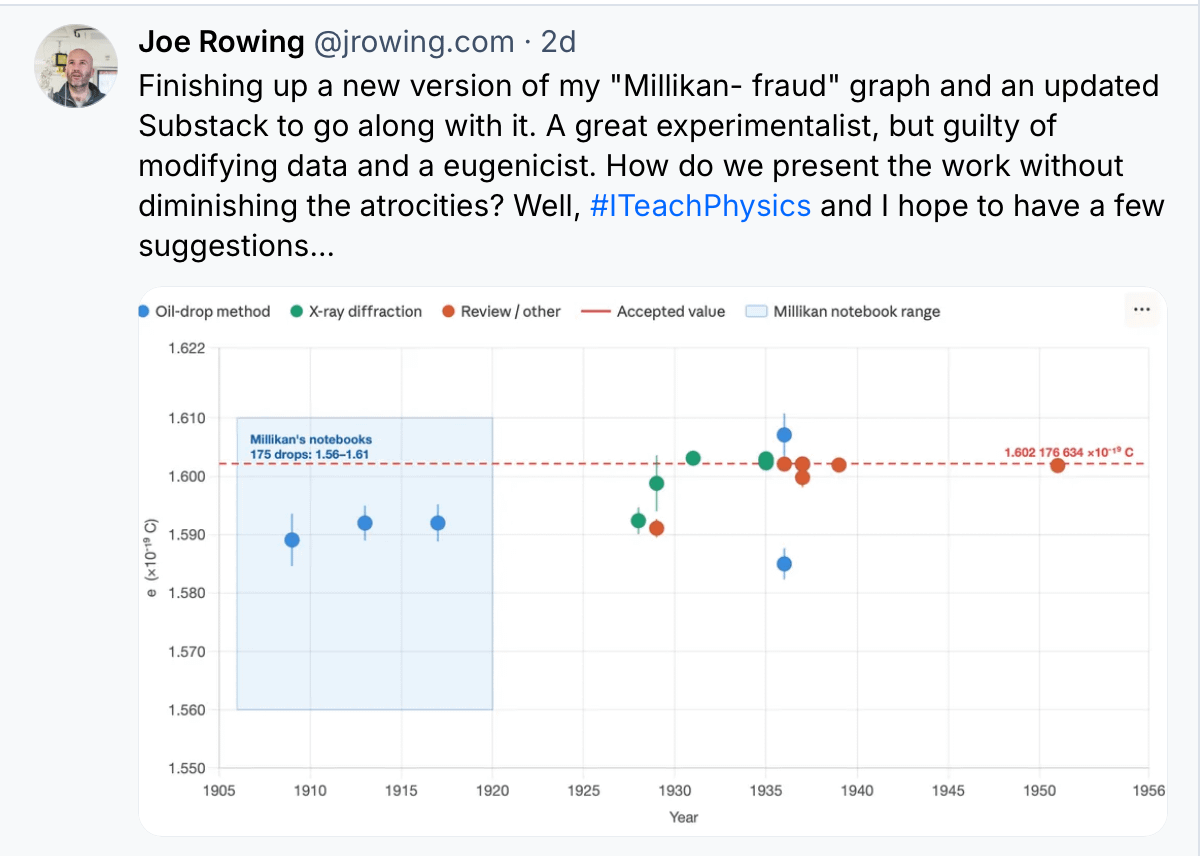
As bit of a teaser to the article, I posted this to ~Bluesky~ (twitter, without Musk, in case you’re unfamiliar);
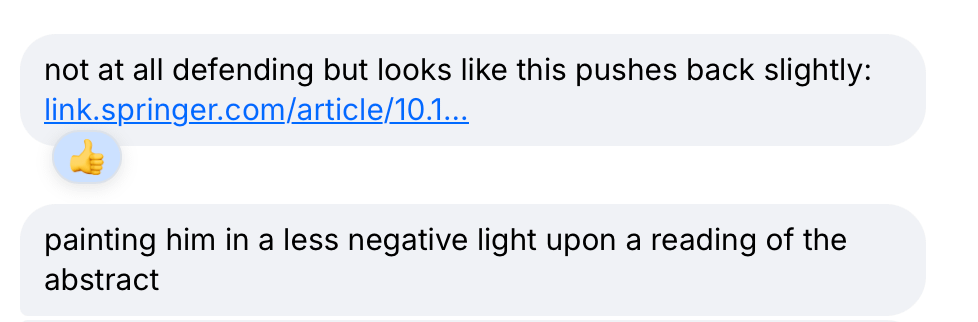
 In doing so I had a few good conversations, and a very important DM:
 In this a I discovered a paper I had entirely overlooked, and had to re-write the lot. More of that side in a sec -
The Experiment and the fraudulent data:
The experiment that won Millikan the Nobel Prize is a famous case study in scientific misconduct - in short:
The experiment itself was elegantly simple: oil droplets were sprayed into a chamber and allowed to fall between two electrically charged plates, where they could be observed through a microscope. By ionising the air with X-rays, Millikan could cause individual droplets to pick up electrons and be pulled upward by the electric field. By carefully balancing gravity against the electric force, he could measure the charge on a single droplet — and he showed that this charge was always a whole-number multiple of one tiny, fixed value.
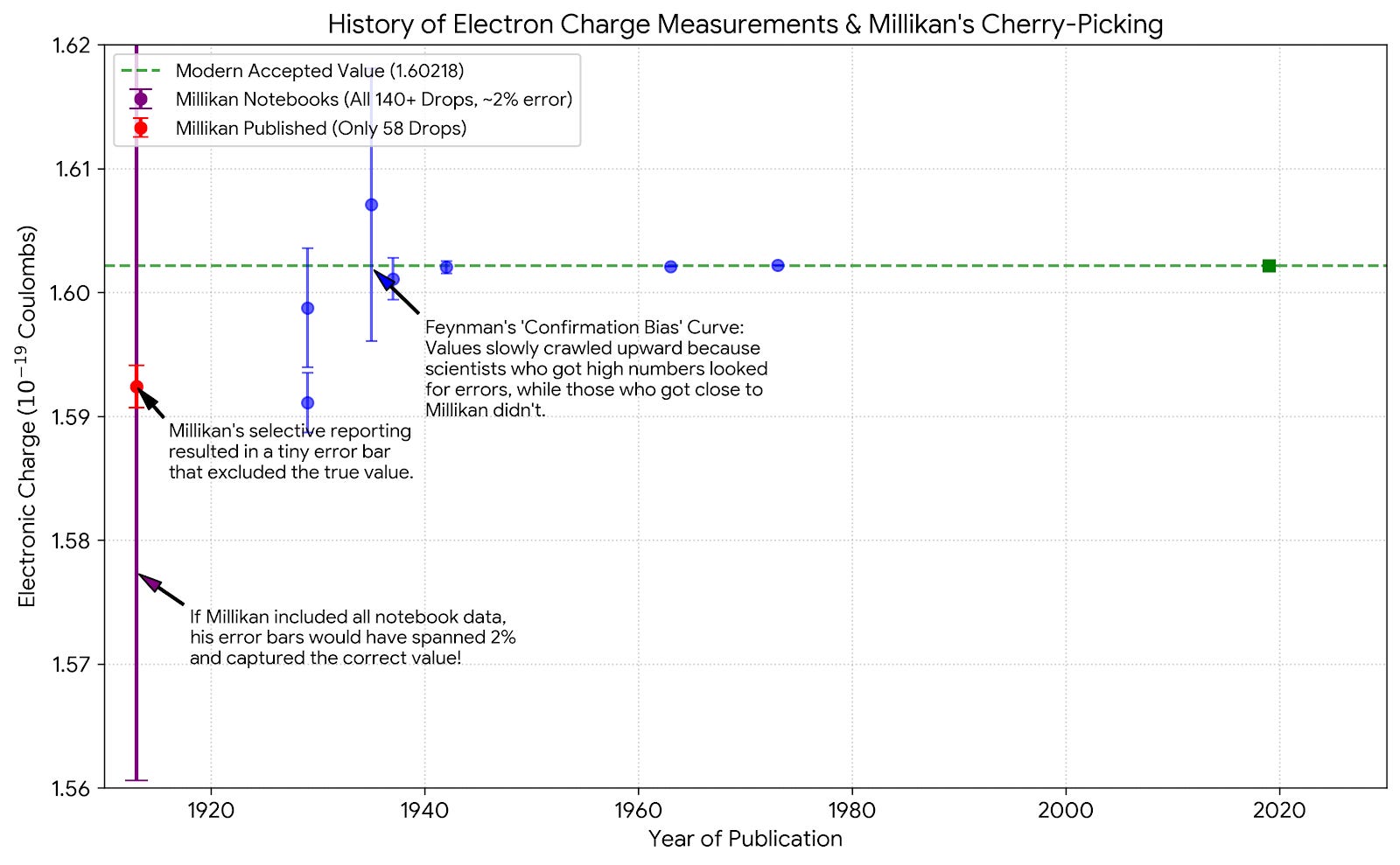
That fixed value was the charge of the electron itself, one of the fundamental constants of the universe, and pinning it down was a genuinely landmark achievement. The trouble is in how he got there and what happened after. If you plot the reported values of the electron’s charge over time after 1913, you find that each successive measurement comes out slightly higher than Millikan’s, and the next one higher still, creeping upward year by year until they finally converge on a number definitively above his original figure.
 Richard Feynman used this pattern as a textbook example of confirmation bias in science: when subsequent experimenters got a number too far above Millikan’s, they assumed something must be wrong and kept looking; when they got a number close to his, they didn’t look so hard. The root cause was partly a straightforward error — he had used an incorrect value for the viscosity of air — but his laboratory notebooks reveal something more deliberate. Of 175 drops he measured, he used only 58 to calculate his final result, with annotations beside the discarded data reading “error high will not use” and “too high by 1.5%.” His published value was 1.592 × 10⁻¹⁹ C; the accepted value today is 1.602 × 10⁻¹⁹ C. He was close, and he was right that charge is quantised — but he got there by quietly discarding the data that told him he was slightly wrong, and a generation of physicists deferring to his authority then repeated that same bias back at him.
Eugenics;
Millikan was a trustee of the Human Betterment Foundation (HBF), a California organisation that advocated for compulsory sterilisation laws. The decision by Caltech and Pomona College to strip his name from buildings was made in direct response to his participation in the eugenics movement through this affiliation. That much is factual and uncontested. (~Caltech Magazine~) However Caltech’s own Committee on Naming and Recognition, in its detailed final report, acknowledged a significant caveat: Millikan did not lead the HBF, nor did he shape its policies. Rather, Millikan lent his prestige — and by extension Caltech’s — to the HBF when he joined its Board of Trustees, likely giving the organisation renewed legitimacy for its educational programme. He joined after a colleague’s death in 1937, late in the HBF’s existence, and the evidence suggests he treated the trusteeship as one of many civic affiliations rather than an ideological project. Then, in 2023, mathematician Thomas Hales published a rigorous 64-page reassessment on arXiv that challenged the foundations of Caltech’s case more sharply. Hales discovered that some of the biologists cited by Caltech’s report as opponents of eugenics were in fact supporters of forced sterilisation — sometimes in the very same quotes used as evidence against Millikan. Furthermore, Millikan never attended any Foundation meetings, and saw his membership as just another of the charitable causes to which he lent his support. On the separate accusation that Millikan helped deprive Japanese Americans of their rights during wartime internment, Hales found the accusation to be false — that on the contrary, Millikan actively campaigned during the war to promote the rights of Japanese Americans. interesting acticle here: ~3 Quarks Daily~ and the paper is here: ~arXiv~ Hales’s conclusion is pointed: Millikan’s beliefs fell within acceptable scientific norms of his day, and all three of Caltech’s scientific witnesses against eugenics were themselves pro-eugenic to varying degrees. I personally take a harder line, Millikan is very far from excused on eugenics. Lending your Nobel Prize-winning name and institutional authority to a sterilisation advocacy organisation — whatever your level of personal engagement - is a genuine moral failure. I will note however that there is a difference in kind between Millikan and William Shockley — a man who spent decades actively campaigning for mass sterilisation based on race. Once Caltech issued its judgment, the American Association of Physics Teachers renamed its own Millikan Medal, and the cascading effect of institutional decisions makes it all but impossible to revisit the verdict. A man who lent his name carelessly, without deep conviction, to an organisation doing terrible things is a different moral case from a man who drove that organisation. So the question of what Millikan actually did, what he believed, and whether the evidence supports the charges made against him is a better classroom tool for that reason.
Part III: The Counter-Examples: Genius with a Conscience
It is tempting, when confronted with this list, to throw up one’s hands and claim that this is simply the tax of genius—that perhaps the same obsessive, boundary-breaking minds required to unlock the universe are fundamentally incompatible with normal human morality. But that is a cop-out. History also gives us physicists of staggering genius who looked at systemic horror, personal malice, or state violence, and chose empathy, integrity, and resistance.
- Lise Meitner (1878–1968): The co-discoverer of nuclear fission, Meitner was unjustly denied the Nobel Prize (which went solely to her collaborator Otto Hahn) largely due to her gender and Jewish heritage (Sime, 1996). Despite being forced to flee Nazi Germany, she was later invited to join the Manhattan Project to build the atomic bomb. She flatly refused, famously declaring, “I will have nothing to do with a bomb.” She spent the rest of her life advocating for the peaceful use of science and nuclear non-proliferation.
- Andrei Sakharov (1921–1989): The brilliant mind behind the Soviet Union’s thermonuclear (hydrogen) bomb. Realizing the apocalyptic stakes of his creation, Sakharov underwent a profound moral awakening (Sakharov, 1990). He risked his freedom, his career, and his life to become an outspoken dissident against the Soviet regime, fighting for civil liberties, human rights, and a nuclear test ban. He was exiled to the closed city of Gorky and subjected to intense state harassment, but he never recanted, earning the Nobel Peace Prize in 1975.
⠀Part VI: The Pedagogical Problem: How Do We Teach This? Confronted with this history, educators face a daunting challenge. How do we present these figures to students? We can’t do as Caltech have done, and pull down their names for if we stop teaching Schrödinger’s wave equation, we stop teaching modern chemistry and solid-state physics. Instead, we need to change how we approach the history of science in the classroom.
1. Humanize, Don’t Deify
The “Great Man” theory of history has poisoned STEM education. Textbooks often present discovery as an immaculate process achieved by flawless, isolated geniuses. It doesn’t help us to reinforce the need for hard work and by shifting the narrative from idol worship to objective human history, we can present these figures as ordinary, flawed people who possessed an extraordinary talent for hard work and a tolerance for the many thousands of times they hit a problem and overcame it. This protects students from the toxic mindset that intellectual superiority excuses personal or social misconduct.
2. Teach Science as a Social Practice
Equations do not exist in a vacuum. The historical context surrounding a discovery is often just as instructive as the discovery itself. When teaching the transistor, educators have a perfect opportunity to spend five minutes discussing William Shockley’s downfall—explaining how his obsession with genetic determinism blinded him to actual data, rendering his later “scientific” work completely useless. In so doing we can prove to students that cognitive bias and prejudice can dismantle even the sharpest analytical minds.
3. Integrate Ethics into STEM Curricula
For too long, academic institutions have treated the Humanities and STEM as completely separate silos. It must be woven into the core curriculum. When teaching nuclear physics, teach the Manhattan Project alongside Joseph Rotblat’s resignation. When teaching the mechanics of rocketry, don’t stop at the moon; talk about the tunnels of Mittelbau-Dora.
The Moral of the Equation
When we learn physics, we must separate the code from the coder. Hooke’s Law remains mathematically true regardless of how he treated his niece. The transistor works flawlessly regardless of William Shockley’s vile racism. The Saturn V rocket reached the moon regardless of the concentration camp labor that birthed its predecessors. We do not have to burn the textbooks, nor do we need to stop teaching their equations. But we do need to stop building altars to the men who wrote them. Genius is not a moral cleanser. When we treat historical figures as flawless icons, we decouple intelligence from ethics, teaching a dangerous lesson that if you are smart enough, the world will forgive you for whatever harm you leave in your wake. They were not gods. They were just humans—capable of looking at the stars, while trampled firmly in the mud of their own malice. What do you think? Can we truly separate the science from the scientist, or does knowing their history change how you look at the textbook? Let’s discuss in the comments. If you enjoyed this post, consider subscribing to the newsletter, sharing it with a friend, or leaving a comment below. Notes from The Science lab is a reader-supported publication. To receive new posts and support my work, consider becoming a free or paid subscriber.
References
- Ball, P. (2014). Serving the Reich: The Struggle for the Soul of Physics under Hitler. University of Chicago Press.
- Clary, D. C. (2021). Schrödinger’s Philosophy of Quantum Mechanics. Springer.
- Einstein, A. (2018). The Travel Diaries of Albert Einstein: The Far East, Palestine, and Spain, 1922-1923 (Z. Rosenkranz, Ed.). Princeton University Press.
- Feynman, R. P. (1985). Surely You’re Joking, Mr. Feynman!: Adventures of a Curious Character. W. W. Norton & Company.
- Gleick, J. (1992). Genius: The Life and Science of Richard Feynman. Pantheon Books.
- Hales, T. (2023). Robert Millikan, Japanese internment, and eugenics. arXiv. ~https://doi.org/10.48550/arxiv.2309.13468~
- Levenson, T. (2010). Newton and the Counterfeiter: The Unknown Detective Career of the World’s Greatest Scientist. Mariner Books.
- Mulligan, L. (1996). Self-Scrutiny and the Study of Nature: Robert Hooke’s Diary as Natural History. Journal of British Studies, 35(3), 311–342. ~https://doi.org/10.1086/386110~ .
- Neufeld, M. J. (2002). Wernher von Braun, the SS, and Concentration Camp Labor: Questions of Moral, Political, and Criminal Responsibility. German Studies Review, 25(1), 57–79. ~https://doi.org/10.2307/1433245~
- Rotblat, aJ. (1985). Leaving the Bomb Project. Bulletin of the Atomic Scientists, 41(7), 16-19.
- Shurkin, J. N. (2006). Broken Genius: The Rise and Fall of William Shockley, Creator of the Electronic Age. Macmillan.
- Sime, R. L. (1996). Lise Meitner: A Life in Physics. University of California Press.
- Westfall, R. S. (1980). Never at Rest: A Biography of Isaac Newton. Cambridge University Press.